








Page 39 - The Connection Bridgewater Somerville Edition, September 2012
Basic HTML Version
View Full Version
Table of Contents
Page 38
Page 40
www.theconnectionsnj.com
Health and Wellness
PAGE 39
SPORTS AND
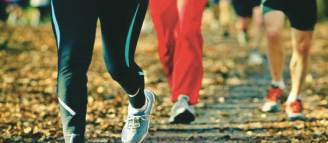
YOUR CHILDREN’S FEET
By: Marco Ucciferri, DPM, FACFAS
Children and Sports
All parents know that children take to sports like
ducks to water. Almost as soon as they start to walk,
they’re chasing balls, swinging sticks, and running
races against nobody in particular.
Children’s sports used to mean baseball, basketball,
or football. That’s changed. Soccer has leapt onto
the youth sports scene, as have wrestling, tennis,
and lacrosse with older children. The starting age
for training in individual sports such as swimming,
skating, track, and gymnastics grows younger every
year.
Parents should encourage their children to partici-
pate in sports but never forget that
competition should be fun. Too much
emphasis on winning can alienate a
child from athletic competition.
Children active in sports programs will
improve their cardiovascular and mus-
culoskeletal systems, coordination, and
state of mind. Participation in sports
develops a sense of self discipline,
teamwork, and recognition of the
importance of a healthy body — good
habits that last a lifetime.
Training Emphasis
Every child physically matures at his or
her own rate and has a different degree of athletic
ability. No amount of training can improve a child’s
natural athletic ability, but training helps improve
coordination and therefore performance.
Early training should emphasize proper technique
and basic movement skills in all sports, especially in
children younger than 10. Podiatric physicians, spe-
cialists in treating the lower extremities, say children
who concentrate on a single sport at too young an
age are more likely to develop injuries of the foot
and ankle. Save specialization in sports for the late
teens, is advised.
Warming up before participating in sports is more
important for adults than children, but it helps
loosen the muscles and prevent injuries in athletes
of all ages. Light jogging and smooth stretching
exercises (be sure not to bounce when stretching)
are all that’s necessary for young athletes. Learning
to stretch at an early age will set a good pattern for
sports activities as the body develops.
Footwear
Whether parents like it or not, part of a child’s
image revolves around footwear. Expensive sneakers
have become fashion statements as much as athlet-
ic equipment. But for good foot health, the condi-
tion of the shoe is more important than the price
tag or brand name.
Podiatric physicians agree it’s often better to buy a
child two $50 pairs of shoes than a single $100 pair,
so the shoes can be rotated to avoid rapid wear
deterioration. Excessive wearing of the outsole, loss
of shoe counter support, or wearing out in the mid-
sole indicate it’s time to replace the shoes.
Because a child’s feet are constantly growing, it is
important to allow at least one finger’s width from
the end of the longest toe when buying shoes.
Remember, proper fit is very important. You can
have the best shoe in the world, but if it doesn’t fit
right, it doesn’t do its job.
In the shoe store, children should put on both
shoes, with their athletic socks and the laces tied
tight, for several minutes to properly check the
shoes’ fit. Shop for shoes in the afternoon, when
the feet are naturally slightly swollen.
In young children, an “all purpose” sports shoe
works well for most sports. A running-specific shoe
is not suitable as an all purpose shoe; moving later-
ally in a running shoe is more difficult and presents
greater risk of injury for children. After the age of
10, sport-specific shoes can help improve perform-
ance and protect the feet. With the exception of the
running shoe, a degree of crossover between sport-
ing shoes is usually not harmful to the feet of a child
athlete.
Rubber cleats are not usually necessary
for children under 10, though they pose
little potential harm for them. They are
most useful on a soft-field sport such as
soccer. Podiatric physicians recommend
molded shoe rubber cleats rather than
the screw-on variety. Metal baseball
spikes can be dangerous and should not
be used until the teenage years.
Growing Bones and Ligaments
The immature bones of children are dif-
ferent from those of adults. The
“growth plates” in children’s bones do
not finish closing until age 15-17 in
boys and 13-15 in girls. When stressed,
these plates are more susceptible to injury than the
tendons and ligaments that support the joints. Liga-
ments tend to “give” before bones in adults.
Podiatric physicians warn repetitive overuse can
cause inflammation of the growth plates. They
advise parents to promote diverse physical activities
for their children rather than one sport. This is espe-
cially important with individual sports such as run-
ning, gymnastics, and tennis, which require long
hours of practice.
Statistics show children who concentrate on just
one sport for long hours at a time are setting them-
selves up for injuries. Because of the susceptibility of
bones with open growth centers to overuse injuries,
sponsors of the Boston Marathon recently increased
the minimum participation age from 16 to 18.
A sports medicine podiatrist can offer a thorough
examination of the entire lower extremity and iden-
tify a leg length imbalance, weakness, or biome-
chanical imbalances that may need to be addressed
to prevent injuries on the athletic field.
Injuries and Treatments
Many children suffer from mild “torsional” imbal-
ances, commonly known as in-toeing and out-toe-
ing. Most children outgrow these imbalances with-
out medical treatment. However, if a child has obvi-
ous torsional imbalances, he or she may be more
susceptible to injury. If that is the case, keep a close
eye out for foot and ankle injuries associated with
sports activity. Foot injuries commonly seen in very
active children include ankle sprains, fractures, shin
splints & stress fractures.
Tips
• Don’t put too much performance pressure
on your child.
• Don’t let children use running shoes for
court sports. An ankle sprain could result.
• Change shoes often. Check the sizing and
wear regularly.
Foot & Ankle
Care Associates
Cosmetic and Pain Relief Specialists
`
FOOT & ANKLE
CARE ASSOCIATES
Cosmetic and Pain Relief Specialists
Dont let foot pain slow you down. We can Help!
9 Physicians. 6 Locations
Serving New Jersey for over 25 years
Most private insurance plans accepted.
Financing available
.
24 hour patient help line
Call 1-866-340-FOOT(3668) or visit
www.njfootdoctors.com
to schedule an appointment!
Hoboken
Piscataway
Manville
Raritan
Martinsville
Hillsborough
1 Route 206N, Somerville, NJ 08876
Monday – Saturday
Call Today
Free Treatment Consultations
908-725-8755
Mention This Ad
and Receive
10% Off
Any Service
Exp. 11/30/12
Our Services
•
Smart Lipo
•
Cellulaze
•
Fractional Laser
Resurfacing
•
C Section Scar Rebase
•
G-Spot Amplification
•
Vampire Facial Lift/
Platelet Rich Plasma (PRP)
•
Laser Hair Removal
•
Laser Skin Resurfacing
•
Dermal Fillers
•
Vein Treatments
•
Sclerotherapy
•
BOTOX
•
Dysport
•
Facials
•
Microdermabrasion
•
Chemical Peel
•
Permanent Cosmetic
Tattoo
•
Minkys Semi Permanent
Eyelash Extentions
The highly skilled professionals
at Body Chic will help you to
discover a new you.
C
E N T E R F OR
C
O SME T I C
E
NH A NC EME N T
A N D
V
E I N
T
R E ATME N T S
www.bodychicnj.com
The Connections NJ